Monday, June 25, 2007

Mind-Blowing Performance

I'm not an NVIDIA GeForce fan for their graphics card, nor a fan of its counterpart the ATI Radeon. But looking on their benchmarks and performance the GeForce 8800 Ultra speaks for itself. Here are the specifications/performance for GeForce 8800 Ultra and the ATI Radeon™ HD 2900.

NVIDIA® Unified Architecture

  • Unified shader architecture
  • GigaThread™ technology
  • Full support for Microsoft® DirectX® 10
    • Geometry shaders
    • Geometry instancing
    • Streamed output
    • Shader Model 4.0
  • Full 128-bit floating point precision through the entire rendering pipeline
NVIDIA Lumenex™ Engine
  • 16x full screen anti-aliasing
  • Transparent multisampling and transparent supersampling
  • 16x angle independent anisotropic filtering
  • 128-bit floating point high dynamic-range (HDR) lighting with anti-aliasing
    • 32-bit per component floating point texture filtering and blending
  • Advanced lossless compression algorithms for color, texture, and z-data
  • Support for normal map compression
  • Z-cull
  • Early-Z
NVIDIA Quantum Effects™ Technology
  • Advanced shader processors architected for physics computation
  • Simulate and render physics effects on the graphics processor
NVIDIA SLI™ Technology1
  • Patented hardware and software technology allows two GeForce-based graphics cards to run in parallel to scale performance and enhance image quality on today's top titles.
NVIDIA PureVideo™ HD Technology2
  • Dedicated on-chip video processor
  • High-definition H.264, VC-1, MPEG2 and WMV9 decode acceleration
  • Advanced spatial-temporal de-interlacing
  • HDCP capable3
  • Spatial-Temporal De-Interlacing
  • Noise Reduction
  • Edge Enhancement
  • Bad Edit Correction
  • Inverse telecine (2:2 and 3:2 pull-down correction)
  • High-quality scaling
  • Video color correction
  • Microsoft® Video Mixing Renderer (VMR) support
Advanced Display Functionality
  • Two dual-link DVI outputs for digital flat panel display resolutions up to 2560x1600
  • Dual integrated 400MHz RAMDACs for analog display resolutions up to and including 2048x1536 at 85Hz
  • Integrated HDTV encoder provides analog TV-output (Component/Composite/S-Video) up to 1080i resolution
  • NVIDIA nView® multi-display technology capability
  • 10-bit display processing
Built for Microsoft® Windows Vista™
  • Full DirectX 10 support
  • Dedicated graphics processor powers the new Windows Vista Aero 3D user interface
  • VMR-based video architecture
High Speed Interfaces
  • Designed for PCI Express® x16
  • Designed for high-speed GDDR3 memory
Operating Systems
  • Windows Vista /Windows Vista 64
  • Windows XP/Windows XP 64
  • Linux
API Support
  • Complete DirectX support, including Microsoft DirectX 10 Shader Model 4.0
  • Full OpenGL® support, including OpenGL 2.0


As for Radeon HD 2900 Series
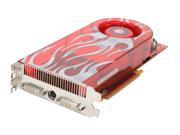

ATI Radeon™ HD 2900 Technology – GPU Specifications
  • 700 million transistors on 80nm HS fabrication process
  • 512-bit 8-channel GDDR3/4 memory interface
  • Ring Bus Memory Controller
    • Fully distributed design with 1024-bit internal ring bus for memory reads and writes
    • Optimized for high performance HDR (High Dynamic Range) rendering at high display resolutions
  • Unified Superscalar Shader Architecture
    • 320 stream processing units
      • Dynamic load balancing and resource allocation for vertex, geometry, and pixel shaders
      • Common instruction set and texture unit access supported for all types of shaders
      • Dedicated branch execution units and texture address processors
    • 128-bit floating point precision for all operations
    • Command processor for reduced CPU overhead
    • Shader instruction and constant caches
    • Up to 80 texture fetches per clock cycle
    • Up to 128 textures per pixel
    • Fully associative multi-level texture cache design
    • DXTC and 3Dc+ texture compression
    • High resolution texture support (up to 8192 x 8192)
    • Fully associative texture Z/stencil cache designs
    • Double-sided hierarchical Z/stencil buffer
    • Early Z test, Re-Z, Z Range optimization, and Fast Z Clear
    • Lossless Z & stencil compression (up to 128:1)
    • Lossless color compression (up to 8:1)
    • 8 render targets (MRTs) with anti-aliasing support
    • Physics processing support
  • Full support for Microsoft® DirectX® 10.0
    • Shader Model 4.0
    • Geometry Shaders
    • Stream Output
    • Integer and Bitwise Operations
    • Alpha to Coverage
    • Constant Buffers
    • State Objects
    • Texture Arrays
  • Dynamic Geometry Acceleration
    • High performance vertex cache
    • Programmable tessellation unit
    • Accelerated geometry shader path for geometry amplification
    • Memory read/write cache for improved stream output performance
  • Anti-aliasing features
    • Multi-sample anti-aliasing (up to 8 samples per pixel)
    • Up to 24x Custom Filter Anti-Aliasing (CFAA) for improved quality
    • Adaptive super-sampling and multi-sampling
    • Temporal anti-aliasing
    • Gamma correct
    • Super AA (CrossFire™ configurations only)
    • All anti-aliasing features compatible with HDR rendering
  • Texture filtering features
    • 2x/4x/8x/16x high quality adaptive anisotropic filtering modes (up to 128 taps per pixel)
    • 128-bit floating point HDR texture filtering
    • Bicubic filtering
    • sRGB filtering (gamma/degamma)
    • Percentage Closer Filtering (PCF)
    • Depth & stencil texture (DST) format support
    • Shared exponent HDR (RGBE 9:9:9:5) texture format support
  • CrossFire™ Multi-GPU Technology
    • Scale up rendering performance and image quality with 2 or more GPUs
    • Integrated compositing engine
    • High performance dual channel interconnect
  • ATI Avivo™ HD Video and Display Platform
    • Two independent display controllers
      • Drive two displays simultaneously with independent resolutions, refresh rates, color controls and video overlays for each display
      • Full 30-bit display processing
      • Programmable piecewise linear gamma correction, color correction, and color space conversion
      • Spatial/temporal dithering provides 30-bit color quality on 24-bit and 18-bit displays
      • High quality pre- and post-scaling engines, with underscan support for all display outputs
      • Content-adaptive de-flicker filtering for interlaced displays
      • Fast, glitch-free mode switching
      • Hardware cursor
    • Two integrated dual-link DVI display outputs
      • Each supports 18-, 24-, and 30-bit digital displays at all resolutions up to 1920x1200 (single-link DVI) or 2560x1600 (dual-link DVI)1
      • Each includes a dual-link HDCP encoder with on-chip key storage for high resolution playback of protected content2
    • Two integrated 400 MHz 30-bit RAMDACs
      • Each supports analog displays connected by VGA at all resolutions up to 2048x15361
    • HDMI output support
      • Supports all display resolutions up to 1920x10801
      • Integrated HD audio controller with multi-channel (5.1) AC3 support, enabling a plug-and-play cable-less audio solution
    • Integrated AMD Xilleon™ HDTV encoder
      • Provides high quality analog TV output (component/S-video/composite)
      • Supports SDTV and HDTV resolutions
      • Underscan and overscan compensation
    • HD decode acceleration for H.264/AVC, VC-1, DivX and MPEG-2 video formats
      • Flawless DVD, HD DVD, and Blu-ray™ playback
      • Motion compensation and IDCT (Inverse Discrete Cosine Transformation)
    • HD video processing
      • Advanced vector adaptive per-pixel de-interlacing
      • De-blocking and noise reduction filtering
      • Edge enhancement
      • Inverse telecine (2:2 and 3:2 pull-down correction)
      • Bad edit correction
      • High fidelity gamma correction, color correction, color space conversion, and scaling
    • MPEG-2, MPEG-4, DivX, WMV9, VC-1, and H.264/AVC encoding and transcoding
    • Seamless integration of pixel shaders with video in real time
    • VGA mode support on all display outputs
  • PCI Express x16 bus interface
  • OpenGL 2.0 support
I will now leave the judging from you on which graphics card you would choose for each of us have different tastes and standards. Happy Gaming!

Sunday, June 3, 2007

Myths and History from Lineage 2

Chapter 1: Interlude - The Chaotic Era


Prophets foretell of its coming. Historians record its passing. But the only ones who can fully understand it are those who have survived its reign… and they are often few and far between.

The so-called Chaotic Era stemmed from the erosion of royal power, that final vestige of the Elmoreden Empire. With each passing year, the king and his court saw their sphere of control shrink further. They could still influence fashion, but ultimately little else. Nor could the ecclesiastical rulers, no matter how full their temple treasuries. The world had simply become too large, too fragmented, too diverse for any single group to dictate the course of events. That was the nature of the chaos that permeated the age.

It was the Battle for Giran Castle that finally showed the truth of a world turned upside down: even an unknown adventurer of common birth could aspire to — and attain — the power hitherto reserved for nobles. Groups of adventurers, bound together as clans, demonstrated their ability to dominate local and regional affairs, particularly when they harnessed the power of the castle.

Chapter 2: Interlude - Protection Against Darkness

The clans became numerous, but most were politically naïve. Shadowy cabals sought to manipulate them in order to advance their own agendas, sparking widespread conflict and disorder. Like a shadow creeping across a darkening room, chaos spread inexorably across the land. Strange new monsters appeared to wreak destruction, and ancient terrors were reawakened.

But as the clans grew stronger, they also grew wiser. They threw off the controlling influence of the cabals and asserted, consciously and intentionally, their own power to shape events. New Heroes and Noblesse gained positions of power and leadership within the clans, imparting a higher moral standard.

Once the bane of villagers and townspeople, the clans gradually became their protectors against the forces of darkness. As their power waxed, even foes like Antharas, the terror of Giran, and Valakas, the lord of Goddard, fled before them.

Once merely the hirelings of lords, the clans had eventually supplanted their masters. Authority was no longer an accident of birth, but the result of merit. Power resided with those who could not only grasp it, but hold it. History had pronounced its verdict... or had it?

Chapter 3: Interlude - The Giran Reunification

The fact is that other, less visible forces were also at play. A new spirit of cooperation between the Five Races – Humans, Elves, Dark Elves, Dwarves, and Orcs – began to grow, particularly following a secret meeting between the elders of each race.

This “Giran Reunification” occurred thanks to the efforts of a mysterious woman in blue, who gathered the elders together and revealed to them the existence of a sixth race, as well as powerful primitive creatures dwelling on a remote island who had somehow survived the ancient War of the Gods.

Faced with new opportunities and potential new threats, the elders began to covertly assist the clans with potent new mass-produced weapons and key strategic information.

Far from the final result, the clans were to be the building blocks of a new Golden Age, one that blended the best attributes of each of the races: the wisdom of the Elves, the strength of the Orcs, the cleverness of the Dwarves, the knowledge of the Dark Elves, and the versatility of the Humans.

Whether that Golden Age has yet been achieved is a topic for another day…

- The Chaotic Throne
Unknown

AMDG teamed up with NCsoft

Lineage 2 from NCsoft will now be in South East Asia and will be distributed in the Philippines, Malaysia and Singapore. The Company behind all this is the Asian Media Development Group (AsianMedia) which is firmly set on the market for online games within the South East Asian region and is projected to generate an estimated revenue of 141 million USD by 2010.

About Asian Media Development Group.


We all know that Lineage 2 The Chaotic Throne is already in its Interlude chapter. A lot of changes and improvements, new skills for each class, increase in land size (more searchable areas), new items including armors and weapons. But it seems that South East Asia is late for this kind of game. A game which is in its first chapter of the chaotic throne will only be available on such regions, some people will no more be thrilled and be excited mainly because they have played it elsewhere. More like in Lineage 2 US or Europe. Some from China, Taiwan, Thailand. It seems that the filipino people and its neighboring countries are a bit late for this game, but hey! Some filipino gamers are already playing L2 in some private servers around the globe, even I myself as a writer and author on this blog had been a developer on some Lineage 2 private servers (Leaked server software, which is Illegal). We just can't wait for it to be released, we know how to play the game, we know what we will do. God speed Lineage 2

Microsoft Surface Unleashed!

Greetings everyone, I'm gLiTcH_, if all goes well with this blog, expect me to contribute some of tech articles, news, and maybe some funny content. Enjoy guys! More power to this blog. Thanks for the invite! My articles will be all original so please leave reference if you plan to blog about this. :)

Microsoft has recently announced their latest new technology that is actually been used in the late 80's. Thing new about this is that this technology has been pushed to the masses and may soon start the era of multi-touch computing. Whether your pro-Microsoft or anti-Microsoft, you have to give them credit for this accomplishment. This technology is freaking awesome and I want one! Too bad this is gonna cost at least $5,000 - $10,000. But I'm sure by next year, more affordable personal ones will be available. I believe that this is the weapon against Apple's iPhone which also uses similar technology.

So what is the Microsoft Surface? Combine touch screen technology with a table..... and a 30-inch screen. Watch the video and see!


July 2007 May 2007 Home